10/08
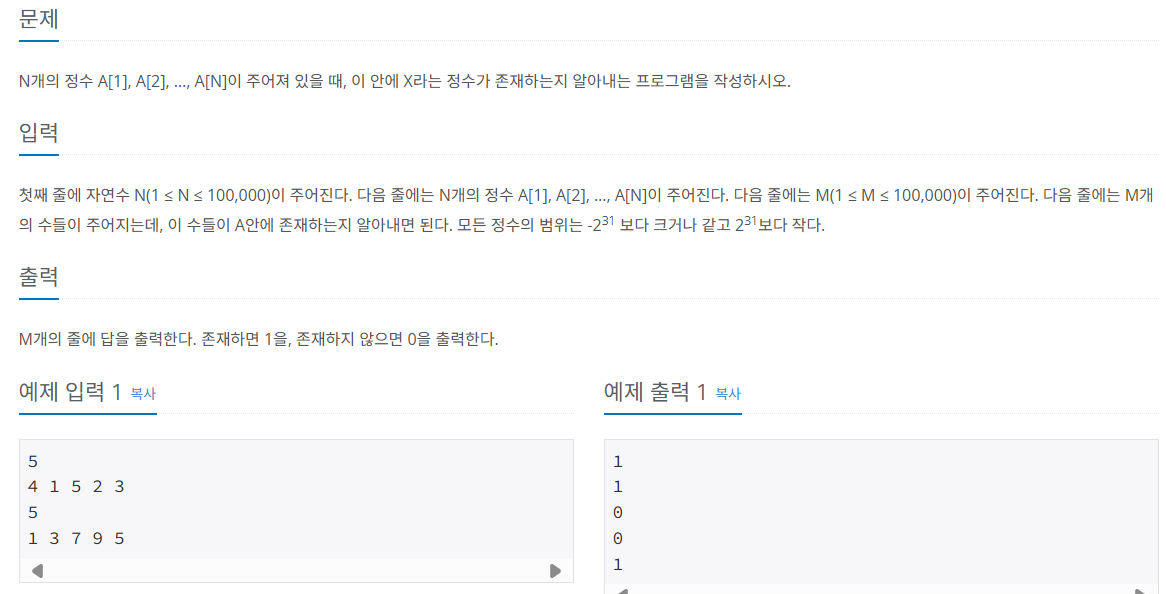
그니까 문제가
4 1 5 2 3 여기 안에 1 3 7 9 5 얘네가 들어가있으면 1, 아님 0을 출력하는거
1 있음 => 1
3 있음 => 1
7 없음 => 0
9 없음 => 0
5 있음 => 1
이렇게
#include <iostream>
#include <map>
using namespace std;

int main(){
    int N, M, x;
    cin >> N;
    map<int, int>m;
    while(N--){
        cin >> x;
        m[x]++;
    }
    cin >> M;
    while(M--){
        cin >> x;
        int ans = m[x] > 0 ? 1 : 0;
        cout << ans << "\n";
    }
}
그래서 map으로 있는지 없는지 count 해서 하게 했는데
시간초과가 나와서
다른 방법을 써야한다.
map 말고 자동으로 체이닝 해주는 unordered set 써보기로!
#include <iostream>
#include <unordered_set>
using namespace std;

int main(){
    int N, M, x;
    cin >> N;
    unordered_set<int>us;
    while(N--){
        cin >> x;
        us.insert(x);
    }
    cin >> M;
    while(M--){
        cin >> x;
        int ans = us.find(x) == us.end()? 0 : 1;
        cout << ans << "\n";
    }
}
unordered_set 써봤는데 이것도 시간초과 나온다
10/31
입출력을 cin, cout 써서 그런거같아서 바꿔줬더니 맞았다
#include <cstdio>
#include <unordered_set>

using namespace std;

int main(){
    int N, M, x;
    scanf("%d", &N);
    unordered_set<int>us;
    while(N--){
        scanf("%d", &x);
        us.insert(x);
    }
    scanf("%d", &M);
    while(M--){
        scanf("%d", &x);
        int ans = us.find(x) == us.end()? 0 : 1;
        printf("%d\n", ans);
    }
}
짜잔~
조금 더 공부해보니까 unordered_set 말고
sort + binary_search을 활용해서 푸는 방법도 있다고 해서 찾아봤다
#include <cstdio>
#include <vector>
#include <algorithm>
using namespace std;

int main(){
    int N, M, x;
    scanf("%d", &N);
    vector <int> v (N);
    for(int i = 0; i<N; i++) scanf("%d", &v[i]);
    sort(v.begin(), v.end());
    scanf("%d", &M);

    while(M--){
        scanf("%d", &x);
        int ans = binary_search(v.begin(), v.end(), x);
        printf("%d\n", ans);
    }
}
이렇게!

위에가 unordered_set으로 푼 거
아래가 sort + binary_search로 푼거
메모리랑 시간 차이가 꽤 나서 왜그런지 궁금해짐
| unordered_set | sort + binary_search | |
| 코드 | unordered_set us; us.insert(x); us.find(x); |
vector v; sort(v.begin(), v.end()); binary_search(v.begin(), v.end(), x); |
| 삽입 | 평균 O(1) | O(N log N) (정렬 포함) |
| 탐색 | 평균 O(1), 최악 O(N) | O(log N) |
| 메모리 사용량 | 높음(해시 버킷) | 낮음 |
| 정렬 | 필요없음 XX | 필요함 OO |
| 입츌력 속도 | 큼 (입출력 느리면 시간초과 위험) | 작음 |
| 성능 안정성 | 데이터 분포 따라 다름 | 매우 안정적 |
| 용도 | 중복제거, 실시간 삽입 위주 | 검색/ 조회 위주 |
둘이 용도가 달라서 쓰임이 다른 듯
| 한 번에 데이터 입력 후, 여러 번 찾기만 함 | ✅ binary_search (정렬 후 탐색) |
| 데이터가 계속 추가/삭제됨 | ✅ unordered_set |
| 메모리 제약이 있음 | binary_search |
| 입력이 많고 불규칙함 | binary_search (충돌 영향 없음) |
| 빠른 중복 체크가 필요함 | unordered_set |
'C++ 문제풀기 > 백준-프로그래머스' 카테고리의 다른 글
| 백준 | 2579. 계단오르기 (0) | 2025.11.04 |
|---|---|
| 백준 | 1931. 회의실 배정 (0) | 2025.10.31 |
| 프로그래머스 | 귤 고르기 (0) | 2025.10.28 |
| 프로그래머스 | 구명보트 (0) | 2025.10.28 |
| 프로그래머스 | 카펫 (0) | 2025.10.28 |